
Renter-Friendly Organization Hacks: 9 Apartment Ideas
Try renter-friendly organization ideas for apartments using freestanding storage, over-door systems, tension rods, magnetic options, and removable mounting.

Rental organization is less about finding products labelled “damage-free” and more about matching the storage method to the surface, load, lease rules, and removal instructions. A removable hook can still damage weak paint, and a tension rod can still mark a delicate finish if it is overtightened.
Renter-Friendly Organization Hacks: Before You Buy: Check Four Things
- Your lease or building rules for drilling, adhesives, and wall mounting.
- The surface: painted drywall, tile, glass, metal, wood, or textured finish.
- The manufacturer’s stated load and compatible surfaces.
- How the product must be removed.
1. Use Adhesive Hooks Only Within Their Rated Use
Adhesive hooks can be useful for lightweight coats, keys, kitchen tools, or cable loops, but load limits vary widely by product and surface. Do not rely on a generic “up to 15 lb” claim. Follow the exact package instructions, surface-preparation requirements, curing time, and removal method.
Decision rule: if the item is valuable, fragile, heavy, or positioned above a bed or sofa, use a more secure solution approved for the wall rather than assuming removable adhesive is appropriate.
2. Use Tension Rods Inside Cabinets and Alcoves
Small tension rods can separate baking sheets, hang spray bottles, or create a temporary rail. Measure the opening and choose a rod designed for that span. Avoid overtightening against weak plaster, soft wood, or delicate finishes.
3. Prefer Freestanding Storage for Heavy Loads
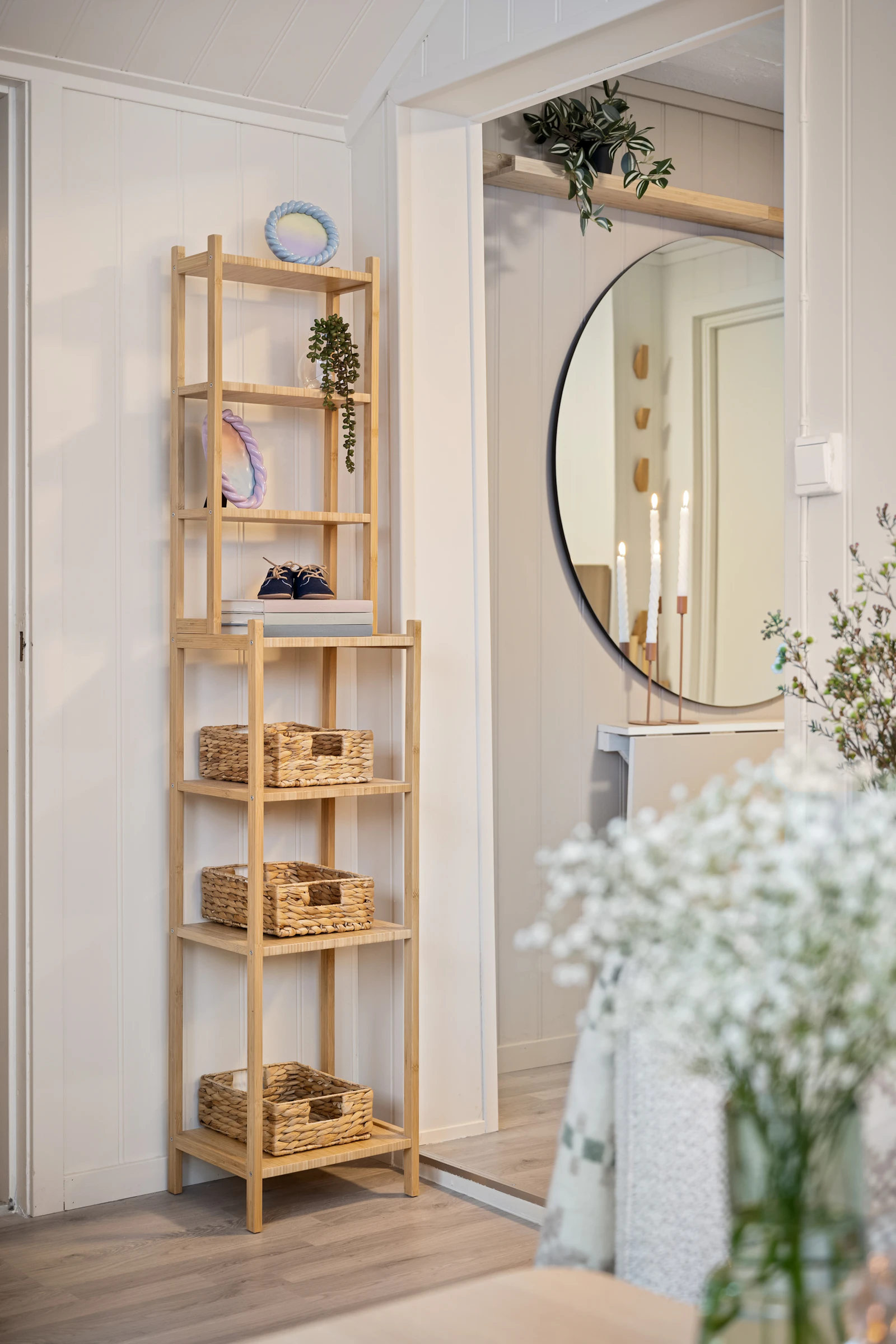
Garment racks, modular cubbies, narrow shelving, and freestanding kitchen carts move with you and do not depend on the wall. Tall units should still be stabilized according to the manufacturer’s safety instructions. For ways to use these pieces without crowding a compact home, see our small-apartment storage guide.
4. Use Over-Door Storage Where Clearance Allows
Over-cabinet towel bars and over-door organizers add storage without drilling. Check bracket thickness, door clearance, and whether the organizer interferes with hinges or seals. At the front door, these same low-impact methods can support a compact entryway drop zone.
5. Use Magnetic Storage on Suitable Metal Surfaces
Magnetic shelves can work well on some refrigerators or washing machines. Test the surface first, keep loads within the product rating, and make sure the rack cannot slide when the appliance door moves.
6. Route Cables Reversibly
Removable cable clips can keep chargers and lighting cords along furniture edges or baseboards. Avoid routing cords under rugs, through doorways, or where they become a trip hazard.
7. Use Under-Bed Storage for High-Capacity, Zero-Wall Storage
Measure the clear height under the frame and choose boxes a few centimetres shorter. Use lidded containers for textiles and seasonal items. This is one of the highest-capacity renter-friendly options because it uses space you already occupy.
8. Use Adjustable Drawer Dividers
Spring-loaded or pressure-fit dividers organize kitchen tools, clothing, and office supplies without glue. Measure drawer width and height so the divider does not stop the drawer from closing.
9. Treat Peel-and-Stick Finishes as Surface-Dependent
“Removable” wallpaper is not risk-free on every paint finish. Test a small, hidden area and check the manufacturer’s surface and cure-time guidance before covering a large wall or cabinet.
Best Options by Risk Level
| Method | Typical alteration risk | Best use |
|---|---|---|
| Freestanding rack | Low | Heavy everyday storage |
| Over-door organizer | Low | Light items |
| Tension rod | Low to medium | Cabinets/alcoves |
| Adhesive system | Surface-dependent | Light, compatible loads |
Choose the Least Permanent Method That Can Safely Carry the Load
For renters, storage choices become easier when you use a simple hierarchy. Start with freestanding furniture, then consider over-door and tension systems, then magnetic solutions on compatible surfaces, and use adhesives only when the exact wall finish and load are suitable. This avoids asking a lightweight removable product to do the work of permanent hardware.
If wall space is the specific problem, our dedicated renter-friendly wall storage guide compares no-drill options room by room and explains what should not be hung with adhesives.
Do a Move-Out Risk Check Before Installing Anything
| Method | Ask before using | Better alternative if unsure |
|---|---|---|
| Adhesive hooks | Is the paint/surface listed as compatible? | Over-door hook or freestanding rack |
| Tension rod | Can both contact points tolerate pressure? | Shelf insert or cabinet organizer |
| Peel-and-stick finish | Is the paint cured and manufacturer-approved? | Decorative panel or removable textile |
| Tall freestanding shelf | Does the manufacturer require anti-tip anchoring? | Lower, wider unit |
Keep a Small “Move-Out File”
Save product instructions for removable hooks, strips, wallpaper, and any other temporary system you install. Photograph the wall before installation if the surface already has marks, and keep any original hardware supplied with the rental. This takes only a few minutes and makes removal less improvised later.
Strongest Takeaway
For renters, the safest hierarchy is usually: freestanding first, over-door second, tension/magnetic third, adhesive only when the surface and load are explicitly compatible. If wall space is your main opportunity, see our guide to renter-friendly wall storage without drilling. For room-specific ideas, see organizing a bedroom without a closet and small-bathroom organization.
Image source: Unsplash, used under the Unsplash License.