Small Home Office Ideas: 12 Practical Ways to Make a Tiny Workspace Work
Small home office ideas for tight spaces, including layout planning, vertical storage, cable control, desk organization and a simple reset routine.
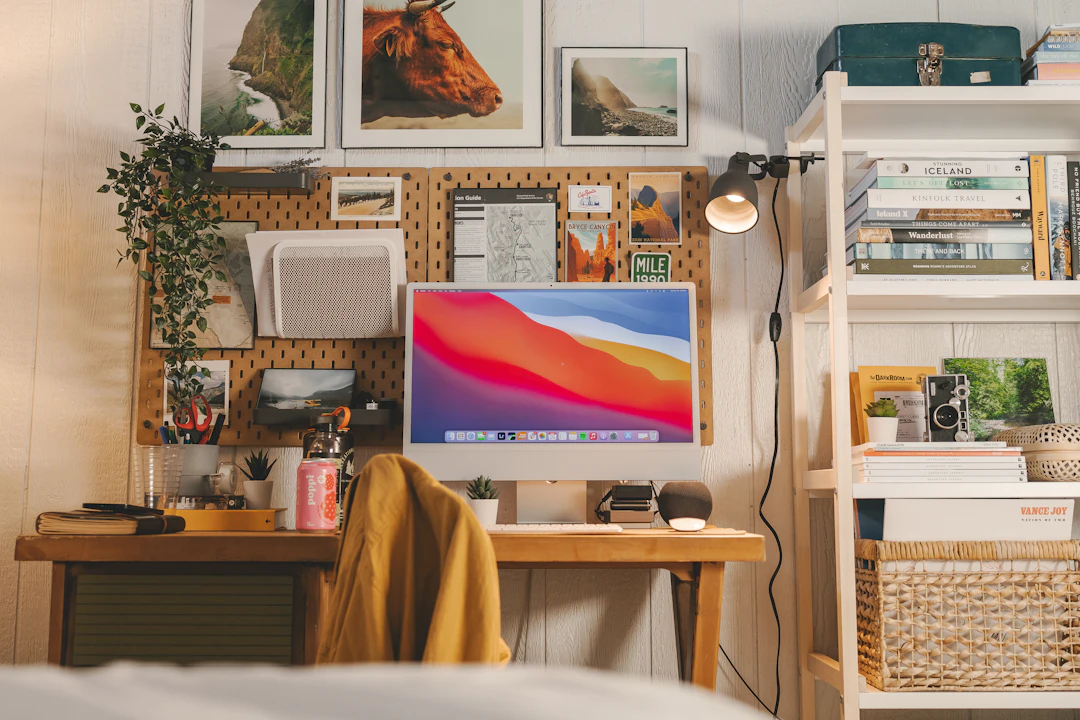
Small home office ideas work best when they protect the actual work zone first and add storage second. In a compact room, bedroom corner, living-room niche, or rental apartment, the desk, chair, cables, paper, lighting, and storage all compete for the same limited space. A setup can look attractive and still feel frustrating if the chair cannot pull back, a cabinet blocks the walkway, or every notebook lives on the desktop.
This guide focuses on practical ways to make a small home office easier to use every day. The goal is not to squeeze more furniture into the room. It is to create a workspace with enough clear surface, comfortable movement, useful storage, and a simple reset routine so the office stays functional after the first week.
Before You Add Furniture to a Small Home Office
Measure the room as a working space rather than only measuring the empty wall. Write down the desk width, desk depth, chair pull-back space, door swing, outlets, radiator or heater clearance, and the narrowest walking route. Then list the equipment that truly needs a permanent home.
- Daily equipment: laptop, monitor, keyboard, mouse, notebook, lamp, headset.
- Weekly-use items: printer, reference books, files, stationery, chargers.
- Occasional items: archived papers, spare cables, packaging, backup devices.
- Shared-room items: clothing, guest bedding, hobby supplies, or household storage.
Small Home Office Ideas: Quick Space Planning Guide
| Problem | First solution to test | Why it helps |
|---|---|---|
| Desk always cluttered | Move storage off the work surface | Protects the area needed for actual work |
| Very little floor space | Tall, shallow storage | Uses height without taking a deep footprint |
| Office is in a bedroom | Create a defined work zone | Stops office supplies spreading into the whole room |
| No drawers | Rolling cart or under-desk drawer | Adds closed storage without replacing the desk |
| Rental restrictions | Freestanding, over-door, or tension storage | Reduces dependence on permanent wall mounting |
| Cables dominate the view | One routed power path | Makes the room easier to clean and visually calmer |
1. Protect the Desk Surface First
The desktop should support active work, not long-term storage. Start with the equipment you use every day, then remove everything else for a week. If an item is needed regularly but does not deserve desktop space, place it one step away in a drawer, caddy, shelf, or cart.
This is the same principle that makes storage in small apartments work: the most valuable space should serve the highest-frequency task. In a home office, that space is usually the center of the desk.
2. Choose a Desk for the Room, Not for the Product Photo
A wide executive desk can overwhelm a small office even when it technically fits. Measure the complete working footprint: desk depth plus chair movement. A shallower rectangular desk often leaves more usable floor area than an L-shaped desk that fills a corner but creates dead space behind the chair.
If you use one laptop and a notebook, a compact desk may be enough. If you use dual monitors, drawing equipment, or paper documents, protect the necessary surface area and save space elsewhere rather than forcing the work onto a desk that is too small.
3. Use the Wall Above the Desk Carefully
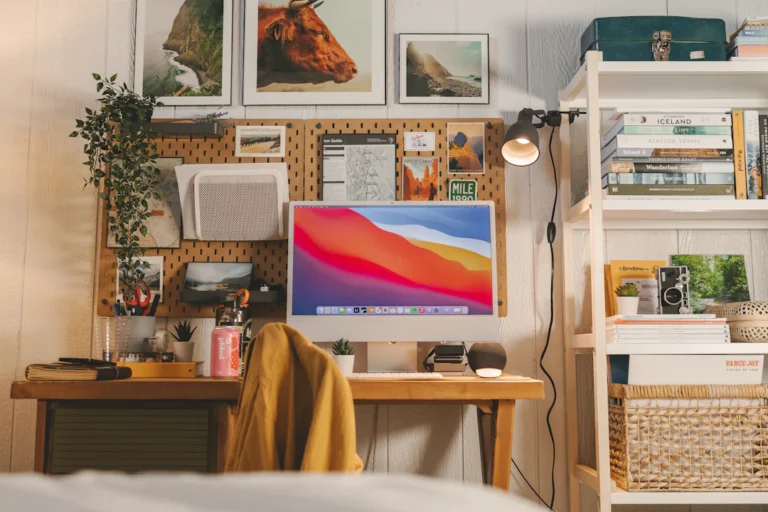
Vertical storage can move lightweight supplies and reference material off the desk. Shelves, a pegboard, wall files, or a rail system can work well when the mounting method suits the wall and load. Renters should check the lease and the exact surface before relying on adhesives.
If drilling is restricted, the methods in our renter-friendly wall storage guide show how to use doors, tension systems, magnets, and freestanding alternatives without assuming that every adhesive product is safe for every wall.
4. Put Heavy Storage Low and Stable
Books, reams of paper, printers, and archive boxes are better on stable lower shelves, a cabinet, or a floor-supported unit. Keeping heavy categories low makes the room feel less top-heavy and reduces the temptation to overload a decorative shelf.
A narrow bookcase can be useful, but tall furniture should follow the manufacturer’s stability and anti-tip instructions. If wall anchoring is required and your rental limits it, consider a lower, wider alternative.
5. Give Cables One Route
Cable clutter often makes a small office look more crowded than it is. Instead of managing every cable separately, create one route from the outlet to the desk. Use a cable tray, reusable ties, a power strip positioned off the floor when appropriate, and enough slack for equipment that moves.
Keep power components ventilated and accessible. Do not hide extension connections inside tightly packed boxes or under rugs. The goal is a cleaner path, not an invisible electrical setup.
6. Use a Rolling Cart Only if It Has a Parking Spot
A rolling cart can hold paper, stationery, a printer, craft tools, or electronics while keeping them near the desk. The important question is where the cart lives when you are not using it. If it permanently blocks the walkway, it is not flexible storage.
Choose a parking spot beside the desk, under a high shelf, or inside a closet. For a broader look at narrow mobile storage, see our small living room storage ideas, where the same circulation-first principle matters.
7. Turn One Drawer or Caddy Into the Daily-Tools Zone
Pens, sticky notes, charging cables, scissors, adapters, and memory cards can make a small desk look chaotic because each item is tiny but visually busy. Give daily tools one container rather than several mini organizers.
A shallow drawer, portable caddy, or small divided box is usually enough. Store duplicates elsewhere. When the container is full, edit the category instead of buying another organizer.
8. Separate Active Paper From Archive Paper
Paper becomes difficult to manage when current documents, receipts, manuals, and old records share one pile. Use a simple three-part system: action, reference, archive. Keep only active paper near the desk, move reference documents to labeled folders, and store true archives outside the immediate work zone.
This prevents the desktop from becoming a filing cabinet. Our upcoming guide to home office paper organization goes deeper into a compact paper system for small spaces.
9. Use the Back of the Door for Light Storage
When the office has a full door, an over-door organizer can hold cables, small supplies, headphones, stationery, or light reference material. Check the door thickness, hinge clearance, and whether the organizer prevents the door from closing properly.
Keep heavy items elsewhere. Door storage works best for light categories that are useful but do not need to be visible all day.
10. Create a Visual Boundary in a Shared Room
If the home office is part of a bedroom or living room, define the work zone with furniture placement rather than filling the room with partitions. A rug, narrow bookcase, wall color, desk lamp, or consistent storage finish can make the office feel intentional.
For bedrooms, protect sleep-related circulation first. The principles in organizing a small bedroom with too much stuff are useful because the office cannot work well if it steals all of the room’s remaining storage.
11. Keep the Floor Around the Chair Clear
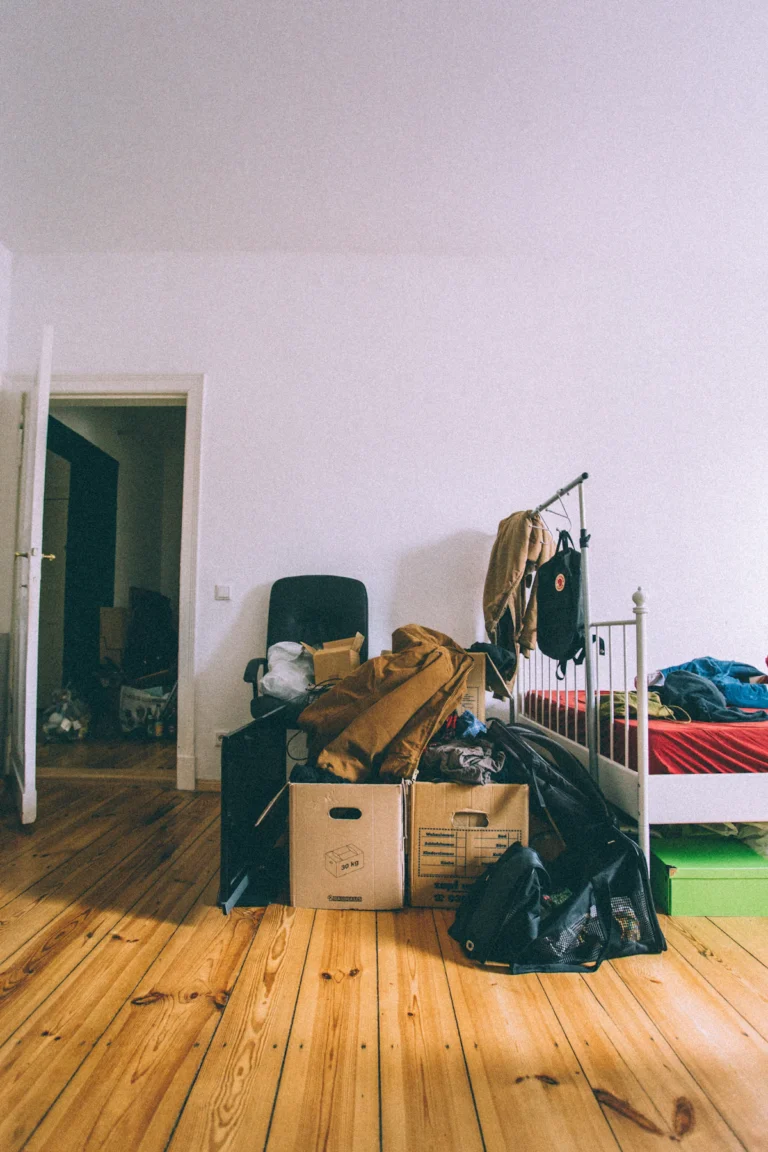
Boxes, bags, printer paper, and cable bundles often collect under the desk because the area looks unused. But the chair needs room to move, and your feet need a comfortable position. Use under-desk storage only where it does not reduce legroom or create something you repeatedly kick.
If the room has no closet, a nearby narrow cabinet or wall-height storage zone is often better than turning every inch under the desk into storage.
12. Build a Five-Minute Shutdown Reset
A small office can become messy quickly because there is almost no buffer space. End the workday with a short reset: return tools to the daily container, put active paper in one tray, remove cups, close the laptop, and clear the center of the desk.
The same small-reset approach used in our 15-minute cleaning routine works well here. The goal is not a perfect office; it is a workspace that is ready when you return.
What Should Stay Out of a Small Home Office?
Limited space becomes easier to manage when the office is not also the default storage room. Be cautious about keeping:
- empty product boxes with no realistic return need;
- duplicate stationery you rarely use;
- old chargers that no longer match current devices;
- large archives that could live elsewhere;
- household overflow that has no connection to work;
- decor that reduces the working surface or blocks useful storage.
- Can the chair move without hitting storage?
- Can you reach the most-used items without standing up?
- Is the center of the desk mostly clear?
- Can the room be reset in five minutes?
- Does every large storage piece earn the floor space it uses?
Best Small Home Office Setup by Space Type
| Space | Best first move | Storage to prioritize |
|---|---|---|
| Dedicated tiny room | Protect chair clearance | Tall shallow shelves and closed lower storage |
| Bedroom corner | Define one work zone | Compact desk, one cart or narrow cabinet |
| Living-room niche | Reduce visual clutter | Closed storage and cable control |
| Rental apartment | Avoid unnecessary permanent mounting | Freestanding, over-door, tension, or removable options |
| Closet office | Protect desk depth and lighting | Vertical files and shallow shelves |
A Simple Priority Order
- Measure the working footprint, including chair movement and doors.
- Protect the desk surface for daily work.
- Move storage vertically or one step away instead of crowding the desktop.
- Control paper and cables before adding decorative storage.
- Create a short reset routine so the system survives normal use.
If storage is the main problem rather than layout, continue with our small home office storage guide. If the desk itself is the clutter point, use the small desk organization guide.
The Bottom Line
The best small home office ideas do not try to use every empty inch. They protect the desk, chair movement, lighting, and work routine first, then add only the storage needed to support those functions. A compact office feels easier to use when daily tools stay close, heavy storage stays stable, paper has a simple system, cables follow one route, and the room can be reset quickly.
Photo sources: Hans and TheStandingDesk on Unsplash, used under the Unsplash License.